
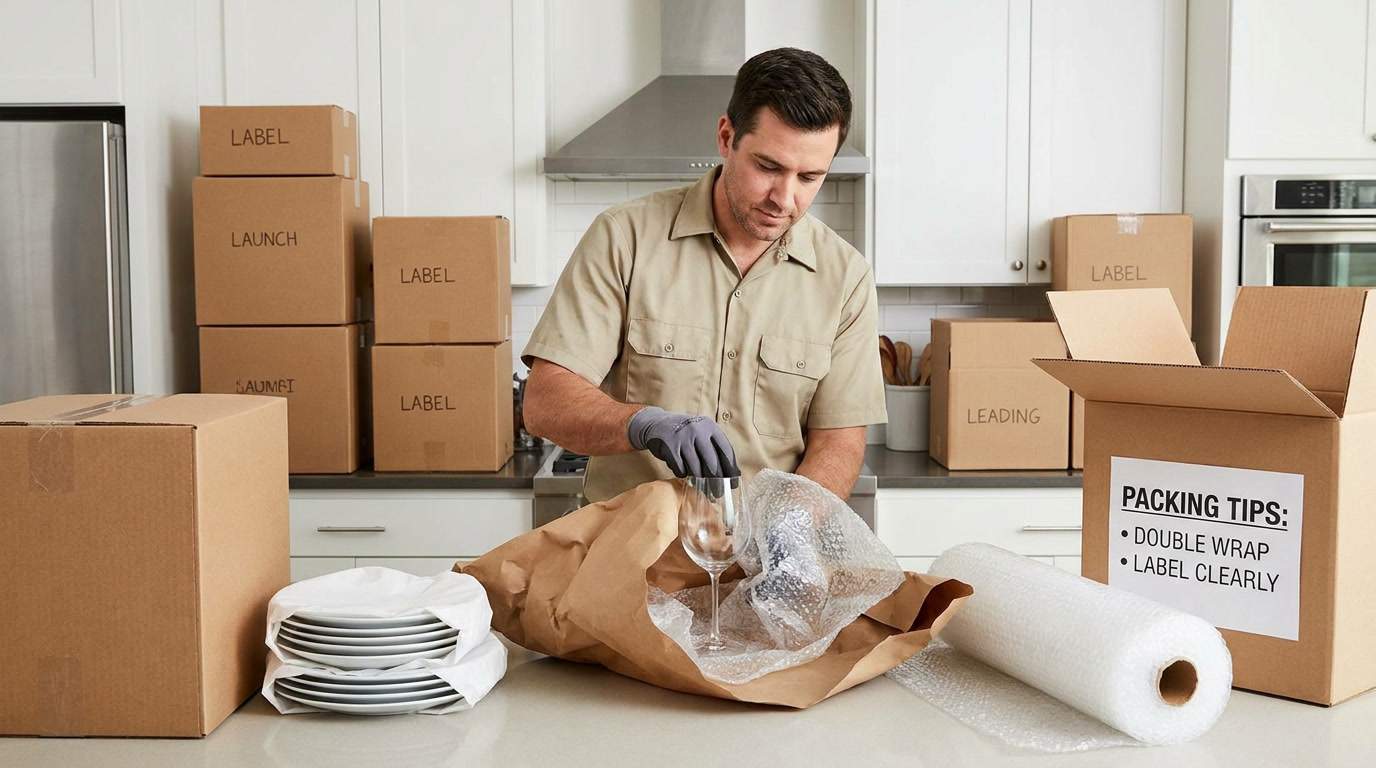

Packing Tips from Professional Movers
The Packing Supplies You Actually Need
Skip the store and order online — you'll save 30–50% on boxes. Here's what Ironmen's crews use:
- Double-wall cardboard boxes for heavy items (books, small appliances)
- Single-wall boxes for clothes, linens, lightweight items
- Dish packs (cell-divided boxes) for plates, glasses, and ceramics
- Wardrobe boxes for hanging clothes (keeps them wrinkle-free)
- Packing paper (not newspaper — the ink transfers)
- Bubble wrap for fragile and high-value items
- 2-inch packing tape — at least 4 rolls for a 2-bedroom home
- Black marker — wide tip, one per floor of your home
How to Pack Fragile Items (Dishes, Glass, Electronics)
Fragile items account for 80% of moving breakage claims. Use this technique:
- Line the bottom of the box with 3 inches of crumpled packing paper
- Wrap each item individually in packing paper (2 sheets for glass, 3 for plates)
- Place plates vertically in boxes (like vinyl records) — they survive transport better vertically than flat
- Never stack glasses upside down — always right-side up with paper stuffed inside
- Fill all voids in the box with crumpled paper — the box should not rattle when you shake it
- Label the box "FRAGILE — THIS SIDE UP" on all 4 sides
For electronics, use the original boxes when possible. If not available, wrap in anti-static bubble wrap and pad heavily. Remove ink cartridges from printers (they leak).
How to Pack Heavy Items Correctly
Rule: heavy items go in small boxes, light items go in large boxes. Never put heavy items in large boxes — they become impossible to carry safely and often get dropped.
- Books: small boxes, 1.5 cubic feet max. Pack standing upright with spines facing the same direction.
- Small appliances: wrap in towels or packing paper, then place in medium boxes
- Tools and hardware: remove blades and sharp parts. Pack in original cases when possible.
- Cast iron cookware: wrap in packing paper, pack in small boxes. One layer per box maximum.
The Labeling System That Changes Everything
Use this system and you'll spend 80% less time searching for things during unpacking:
- Label the top AND one side of every box
- Include: room + contents + priority (1=unpack first, 3=unpack last)
- Example: "KITCHEN — Everyday Dishes — P1" or "OFFICE — Misc Books — P3"
- Number each box and keep a simple spreadsheet: "Box 14 — Bedroom 2 — Winter clothes"
The numbered spreadsheet is also essential for insurance claims — you'll be able to identify exactly what was in a box if something is damaged or missing.
See also: How to Prepare for a Long-Distance Move and our Moving Cost Guide.