
Moving Out of an SF Apartment With Stairs or No Elevator
By Ironmen Moving and Storage, Ironmen Moving and Storage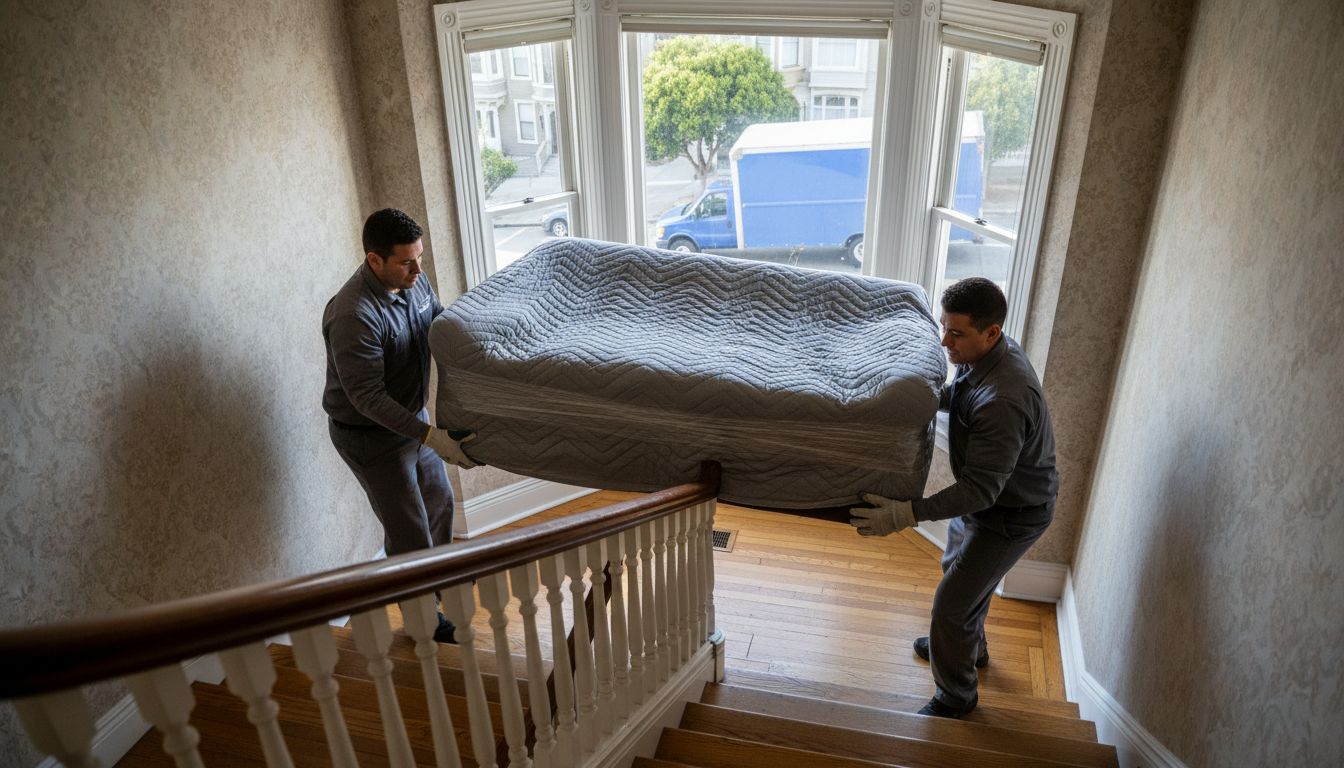
The best way to move out of a San Francisco apartment with stairs, no elevator, or limited parking is to book a professional local moving crew that surveys the building first, then solve the three constraints separately: secure legal truck space with an SFMTA temporary no-parking permit, measure and clear the stair path, and confirm your building's move window and insurance requirements in writing.
- Parking comes first. SFMTA temporary no-parking signs are commonly posted at least 72 hours ahead, so start there, not with boxes.
- Measure the tightest turn, not the room. Stair landings and door diagonals decide what comes out whole.
- Get building rules in writing: move-out windows, elevator reservations, and a certificate of insurance naming your management company.
- Ask how stairs and long carries are quoted before you book, so the final invoice holds no surprises.
- Secure storage bridges the gap when your lease ends before the new place is ready.
Why a San Francisco walk-up is a logistics problem, not a strength problem
Most of the city's housing stock was built long before anyone imagined a sectional sofa or a king mattress. Victorian and Edwardian flats stack two or three flights above a garage, with a hard turn at every landing and a front door that opens onto a hill.
The moves that go wrong are almost never the ones where the crew was not strong enough. They go wrong because the truck had nowhere legal to stop, the building rejected the crew at the door for missing paperwork, or an item was carried up two flights only to jam at a stairwell turn. Every one of those is preventable with a survey and a plan.
How do I solve parking before moving out?
Solve parking first by confirming legal truck space, because the truck's position sets the length of every carry and the carry is what drives the clock.
- Apply for an SFMTA temporary no-parking permit. The signs are commonly required to be posted on the block at least 72 hours before the move, so apply well ahead and confirm current rules and lead times directly with SFMTA.
- Photograph your block at the actual move time. A street that looks open at 2pm can be full at 8am. Note driveway cuts, bus zones, transit-only lanes, and street cleaning days.
- Check the grade and the turn radius. Steep blocks and narrow one-way streets can make a full-size truck the wrong tool, and it is better to learn that during the estimate than on the day.
- Ask whether a smaller shuttle vehicle is the right call. On some blocks, loading a smaller vehicle at the curb and transferring to the main truck nearby is the faster, safer route.
How do I measure stairs for a San Francisco apartment move?
Measure the pinch points before moving day, because furniture usually fails at stair landings, door openings, and other tight turns. Before moving day, measure and write down the narrowest stair width, the headroom at each landing, the door opening diagonally, and any handrail that protrudes into the path.
Then compare those numbers against your largest pieces. Anything that does not clear needs a plan: disassembly, removing a door from its hinges, or professional crating for fragile or high-value items that cannot take a scraped corner on a tight turn.
The three constraints and what actually solves each
| Constraint | What usually goes wrong | The fix |
|---|---|---|
| Stairs | A large item jams at a landing after two flights of effort | Pre-measure pinch points, plan disassembly, crate fragile pieces |
| No elevator | Loose or heavy boxes turn one trip into four | Professional packing in uniform, correctly weighted cartons |
| Limited parking | Truck parks a block away and every carry doubles | SFMTA no-parking permit posted in advance, plus a block survey |
Step 3: Get the building's rules in writing
Managed buildings and HOAs on both ends of the move often set conditions, and they enforce them at the door. Confirm these before the day:
- Approved move windows, which are frequently limited to weekday business hours.
- A certificate of insurance naming the building owner or management company, requested from your mover with enough lead time to be issued and approved.
- Freight elevator reservations at your destination, if it has one, along with any required floor and wall protection.
- Loading zone or garage access rules, including height clearances that a full-size truck cannot meet.
Step 4: Pack so the carry is short and safe
On a stair move, packing quality is a safety decision. Uniform cartons stack and carry cleanly; mismatched bags and open bins do not. Overloaded book boxes are the single most common cause of a slow, awkward descent.
Professional packing services matter more here than in a ground-floor move, because a crew that packs the home also knows exactly what is in each carton, how it should be handled on the turn, and what needs crating rather than a blanket. That is the same reason a walk-up benefits from an experienced local moving crew rather than an improvised one.
What if my new place is not ready when my lease ends?
Use secure storage when your lease ends before your new place is ready. If your keys are due back before the new place is available, moving everything once into secure storage and delivering later is far better than carrying your belongings down three flights twice.
It also helps when the destination building restricts move-in days. Load out on your schedule, hold the shipment safely, and deliver inside the window the building allows.
What to ask before you book
- Will you survey the building, the stairs, and the block before quoting?
- How are stairs, flights, and long carries reflected in the estimate? Get the answer in writing.
- Can you issue a certificate of insurance for my building, and how quickly?
- What gets disassembled, what gets crated, and who handles reassembly at delivery?
Plan your San Francisco stair move with Ironmen Moving and Storage
Ironmen Moving and Storage handles local, long-distance, and international moves across San Francisco, the Peninsula, the East Bay, the South Bay, and Marin, including packing, loading, crating, secure storage, and destination delivery. Request an estimate through ironmenmovingandstorage.com, tell us the flight count and the parking situation, and we will build the plan around your building rather than around the truck. For a closer look at how we handle this exact combination, see our guide to the best SF apartment movers for stairs, elevators, and no parking.
Frequently Asked Questions
In most cases yes, you need an SFMTA temporary no-parking permit so the truck has legal curb space. Signs are commonly posted at least 72 hours before the move, so apply early and confirm current rules with SFMTA.
By measuring the pinch points first, then disassembling, removing doors from hinges, or rotating pieces through the door diagonal. Fragile or high-value items are crated so a tight turn cannot damage them.
The move is planned around a shorter legal stopping point, which may mean loading a smaller vehicle at the curb and transferring to the main truck nearby. Flagging a steep or narrow block during the estimate is what prevents day-of delays.
Many managed buildings and HOAs in San Francisco require one naming the owner or management company. Request it from your mover several days ahead so it can be issued and approved before move day.
Use secure storage so your belongings are loaded out once and delivered when the new home is available. This also helps when a destination building limits move-in to specific days or hours.
Have a question about this? Call 1-800-326-2099 or request a quote.