
Crating Cost in the San Francisco Bay Area
By Ironmen Moving and Storage, Ironmen Moving and Storage
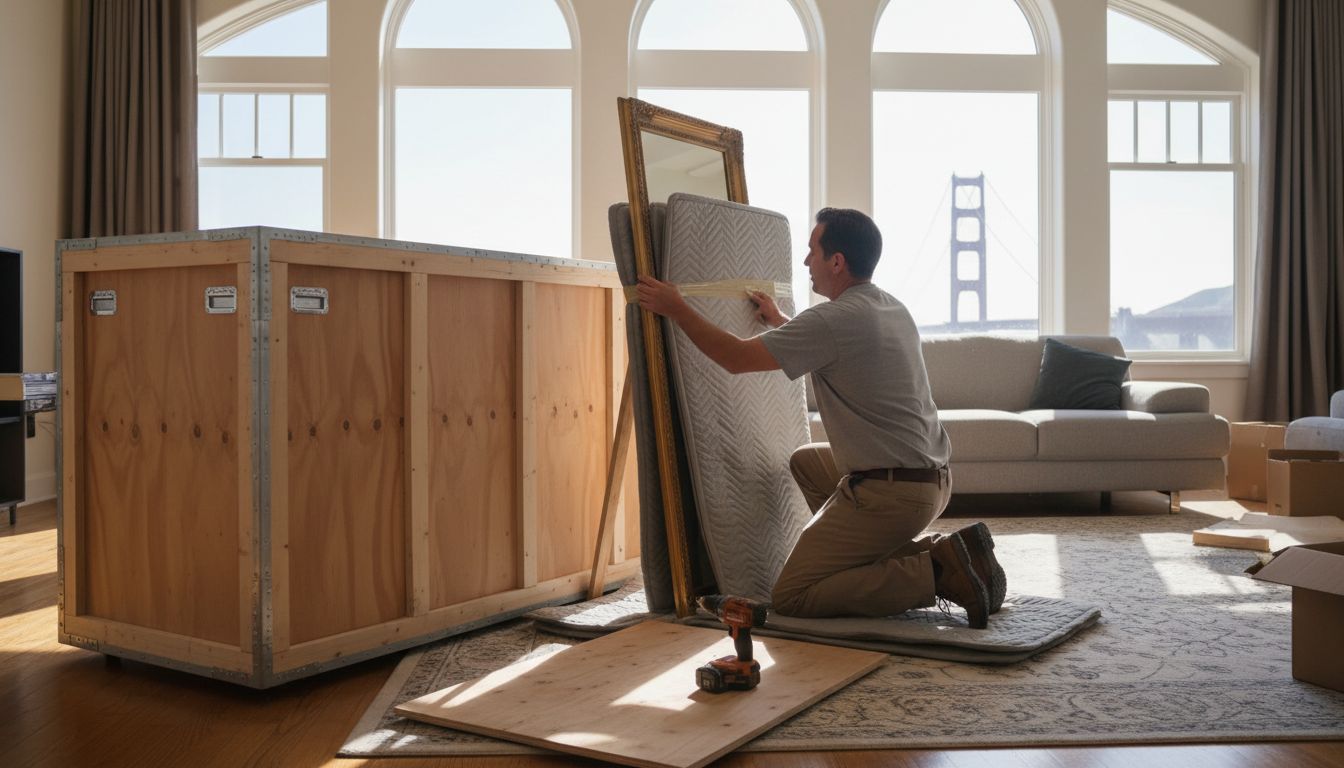
Crating in the San Francisco Bay Area is priced per item, not by a flat rate. Cost is driven by the crate's dimensions, the material and padding needed, whether the crate is built on site or in a shop, and whether the item ships local, long-distance, or overseas. Ironmen Moving and Storage quotes each crate individually after reviewing the piece.
- Crating is quoted per item - a small painting and a nine-foot sculpture are not the same job.
- Size drives cost more than weight, because the crate is built around the item's outer dimensions.
- International crating costs more than local crating - it has to survive ocean or air freight and customs handling.
- Get the crate quoted as part of the full move estimate, not as a separate afterthought.
- Ironmen crates for local, long-distance, and international moves across the Bay Area and beyond.
What Actually Determines Your Crating Price
There is no single Bay Area crating rate, and any company quoting one without seeing the item is guessing. A crate is a custom-built box, so the price follows what has to be built.
These are the factors that move the number up or down:
- Outer dimensions. The crate is built around the item plus padding and clearance. A tall or wide piece needs more lumber, more panels, and more labor - even if it is light.
- Weight and structural load. Heavy stone, metal, or machinery needs a reinforced base and often skids so a pallet jack or forklift can lift it safely.
- Fragility and interior padding. Glass, marble, screens, and fine art need foam blocking, floating suspension, or corner protection inside the crate.
- Shape. A flat panel crate is simple. An irregular sculpture, a chandelier, or an odd-angled table takes custom internal bracing.
- On-site build vs shop build. Building a crate inside your Palo Alto condo or a San Francisco walk-up takes more time and care than building it in a controlled space.
- Destination. Local crating in the East Bay is a different build standard than a crate going into an ocean container to another country.
- Access. Stairs, elevators, tight hallways, and street parking limits in San Francisco and Berkeley all add handling time.
Why Size Matters More Than Weight
People often assume a heavy item is the expensive one. In crating, volume usually costs more than mass. A large but lightweight item - a wide canvas, a tall mirror, a bulky light fixture - still requires a full custom box built to its outer edges.
That is also why crating charges show up on freight quotes: a crate adds real dimensions to a shipment. On international moves, the crated size affects how the piece fits into a container.
Local vs Long-Distance vs International Crating
The same item can be crated three different ways depending on where it is going. Each standard has a different build cost.
- Local Bay Area moves - protection for a short, controlled trip between two points, often the simplest build.
- Long-distance moves - the crate has to survive days on the road, multiple handling points, and load shifting inside a trailer.
- International moves - the strongest and most expensive build. The crate must handle ocean freight or air freight, port handling, and customs inspection, and it must be documented properly for export.
Ironmen Moving and Storage handles all three, including customs documentation, ocean freight, air freight, and destination delivery, so the crate is built to match how the item will actually travel.
If your piece is flying rather than sailing, it helps to understand air freight cost in the San Francisco Bay Area alongside the crating build, since the two are quoted together on international shipments.
What Typically Gets Crated
Not everything needs a crate. Most household goods are fine with professional padding and blankets. Crating is for items where a scratch or a crack is not recoverable.
- Fine art, original paintings, and framed pieces
- Large mirrors and glass tabletops
- Marble, granite, and stone surfaces
- Sculptures and irregular art objects
- Antiques and heirloom furniture
- Large flat-screen televisions and display panels
- Chandeliers and delicate light fixtures
- Musical instruments and specialty equipment
How to Get an Accurate Crating Quote
The fastest way to a real number is to give real information. Before you ask for a price, gather this for each item:
- Measurements - height, width, and depth at the widest points.
- Approximate weight, or at least whether one person, two people, or equipment is needed to lift it.
- Photos from a few angles, including any fragile or protruding parts.
- Material - glass, stone, canvas, wood, electronics.
- Destination - local Bay Area, another state, or another country.
- Access details - floor number, elevator, stairs, and parking situation.
With that, crating can be quoted alongside your packing and loading costs as one clear estimate instead of a surprise line item later.
Crating and Storage Together
If your item is going into secure storage between homes, crating is usually worth it. A crated piece stacks safely, resists pressure from surrounding items, and stays protected through both the move in and the move out - which means you are only paying to build it once for two handling cycles.
Get Your Crating Quoted
Tell us what needs crating and where it is going, and we will build the protection around the piece - not around a price list. Ironmen Moving and Storage crates for local, long-distance, and international moves throughout San Francisco, the Peninsula, South Bay, East Bay, and North Bay. Request your estimate today and get the crating priced in writing before moving day.
Frequently Asked Questions
How much does crating cost in the San Francisco Bay Area?
Crating is priced per item based on the crate's dimensions, materials, padding, and destination. Ironmen Moving and Storage quotes each crate individually after reviewing the item's size, weight, and where it is shipping.
Why is crating priced per item instead of a flat rate?
Every crate is custom built around one specific object, so lumber, padding, and labor change with each piece. A flat rate would either overcharge simple items or under-protect complex ones.
Does international crating cost more than local crating?
Yes. International crates are built to a stronger standard because they must survive ocean or air freight, port handling, and customs inspection, which requires more material and reinforcement.
What items usually need crating?
Fine art, large mirrors, glass tabletops, stone and marble, sculptures, antiques, chandeliers, and oversized televisions are the most common. Standard household furniture is normally protected with professional padding instead.
What do you need from me to quote a crate?
Send the item's height, width, and depth, an approximate weight, photos from a few angles, and the destination. Access details like stairs or elevator use help finalize the estimate.
Have a question about this? Call 1-800-326-2099 or request a quote.